
CSS 2021, Q4: How CPEC phase II will galvanize industrialization and employment in Pakistan?
CSS 2025, Q4: Explore the significance of CPEC for the economic development of Pakistan. What are its potential challenges and opportunities?
Syllabus topic: Topic III of the CSS Pakistan Affairs syllabus.
Short answer
CPEC is the flagship of China’s Belt and Road Initiative and a potential game changer for the region, offering China a short route to the Arabian Sea and Pakistan the role of a trade hub. Its first phase ended Pakistan’s energy crisis and built infrastructure; its second phase, SEZs, ML-1, agriculture and IT, can drive industrialisation and jobs.
Outline for quick revision
- Introduction
- CPEC at a Glance
- CPEC as the Flagship of BRI and a Regional Game Changer: Flagship of the Belt and Road Initiative; China’s shortest route to the Arabian Sea; Regional connectivity; Strategic partnership; Opposition from rivals
- How Phase II Can Galvanise Industrialisation and Employment: Special Economic Zones (SEZs); Relocation of Chinese industry; Main Line-1 railway; Agriculture and IT cooperation; Skills and technology transfer; New momentum: CPEC 2.0
- Significance of CPEC for Pakistan’s Economic Development: End of the energy crisis; Infrastructure; Investment and growth; Development of Balochistan
- Challenges and Opportunities: Challenges; Opportunities
- Conclusion
Reference colours:
Quotation / documentPersonality / historySyllabus bookCurrent referenceOfficial report / policy
How to use this answer: for 2017 lead with Sections 2-3 and 6; for 2021 lead with Sections 2 and 4; for 2025 lead with Sections 2, 5 and 6. Sections 1 and 7 suit all three.
1. Introduction
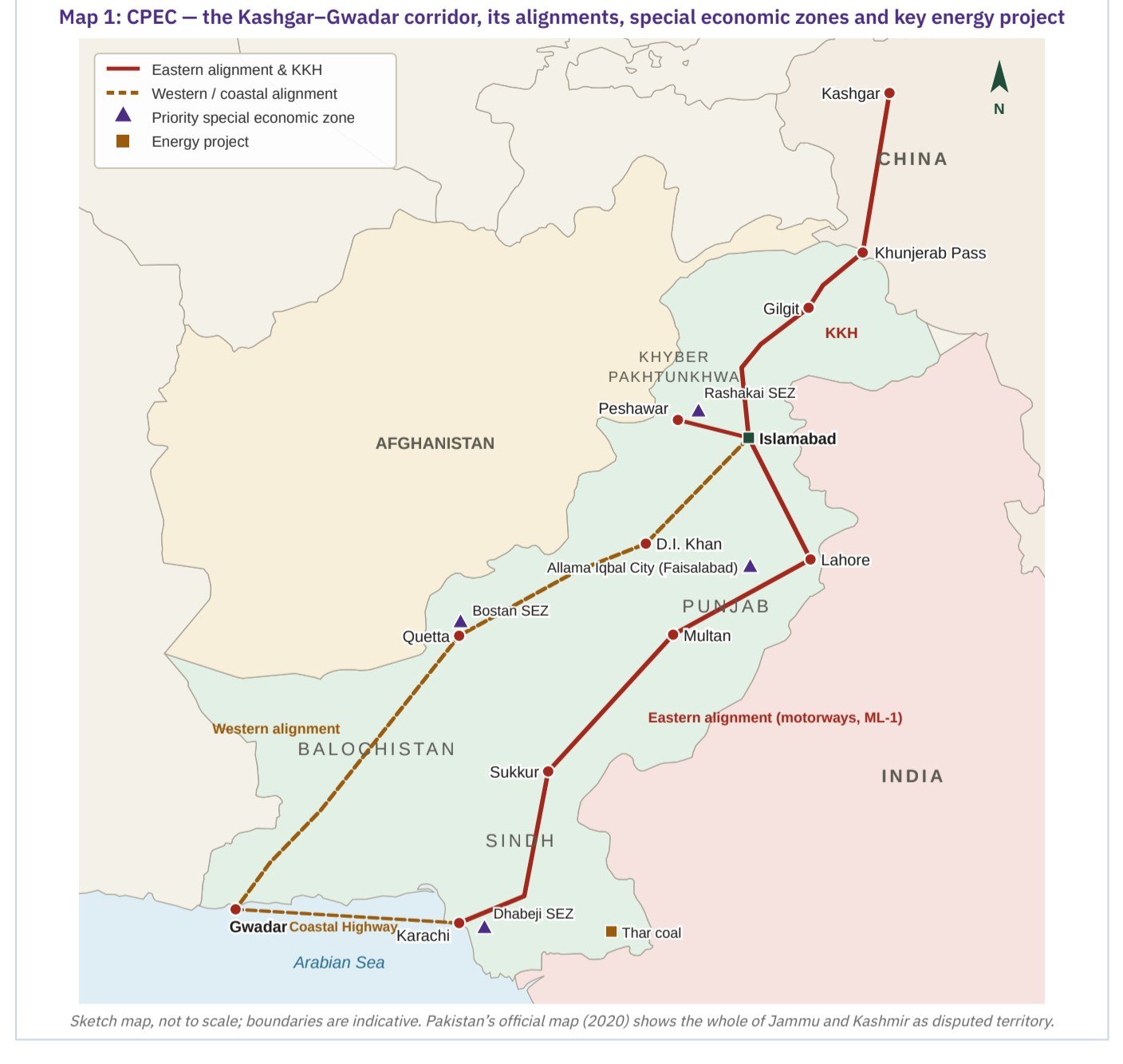
The China-Pakistan Economic Corridor is a network of roads, railways, energy projects, ports and special economic zones linking Kashgar in western China to Gwadar on the Arabian Sea, about 3,000 km away. Launched during President Xi Jinping’s visit to Pakistan in April 2015 with an initial value of $46 billion, it was later expanded to about $62 billion. CPEC is the flagship of China’s Belt and Road Initiative (BRI). Its first phase rescued Pakistan from an energy crisis and built infrastructure; its second phase aims at industrialisation, jobs and exports. Its success depends on overcoming security threats, debt pressures and slow implementation.
2. CPEC at a Glance
| Aspect | Phase I (2015-2020) | Phase II (2020 onwards) |
|---|---|---|
| Focus | energy and infrastructure | industry, agriculture, IT, socio-economic |
| Key projects | power plants, M-5, KKH, Gwadar | SEZs, ML-1, agri and IT cooperation |
| Investors | mainly Chinese state-backed | B2B, private, relocated industry |
- Kashgar: Xinjiang, China
- Khunjerab: Karakoram Highway
- Islamabad-Lahore: motorways, ML-1
- Multan-Sukkur-Karachi: M-5, ports
- Gwadar: deep-sea port
3. CPEC as the Flagship of BRI and a Regional Game Changer
Flagship of the Belt and Road Initiative
The BRI, announced by President Xi in 2013, aims to connect China with Asia, Africa and Europe. CPEC is widely described as its flagship: it was among the first corridors launched, received some of the largest investments, and is the BRI’s showcase in South Asia.
China’s shortest route to the Arabian Sea
Most of China’s oil imports from the Gulf travel through the narrow Strait of Malacca, which could be blocked in a crisis, the so-called “Malacca dilemma”. Gwadar, only a short distance from the Strait of Hormuz, offers western China a much shorter alternative route to the Arabian Sea. This gives CPEC strategic value for China beyond trade.
Regional connectivity
Through its roads, railways and ports, CPEC can link China, landlocked Central Asia, Afghanistan, Iran and the Gulf through Pakistan. If these links are completed, Pakistan would become not just a transit route but a hub for trade, logistics and energy. This is why CPEC is called a “regional game changer”.
Strategic partnership
CPEC turns the long-standing Pakistan-China political and military friendship into an economic partnership, the “all-weather strategic cooperative partnership”. It gives Pakistan a powerful economic ally at a time when Western investment is limited, and an economic counterweight to India in the region.
Opposition from rivals
India opposes CPEC because it passes through Gilgit-Baltistan, which India claims as part of Jammu and Kashmir, and it has boycotted BRI summits; the United States has criticised the corridor’s debt terms.
4. How Phase II Can Galvanise Industrialisation and Employment
Special Economic Zones (SEZs)
Nine priority special economic zones were planned, led by Rashakai (Khyber Pakhtunkhwa), Dhabeji (Sindh), Allama Iqbal Industrial City (Faisalabad) and Bostan (Balochistan). They offer tax holidays, duty-free import of machinery and ready infrastructure to attract Chinese and local industry. Spread across all provinces, they are meant to create industrial jobs where people live.
Relocation of Chinese industry
Rising wages in China are pushing labour-intensive industries such as textiles, footwear, electronics assembly and furniture to cheaper countries. With a young labour force, Pakistan can attract part of this relocation through the SEZs. Each relocated factory would create jobs and add to exports.
Main Line-1 railway
Upgrading the 1,700 km Karachi-Peshawar railway would allow faster trains and heavier freight. Moving goods by rail rather than road would cut transport costs and connect industrial zones to the ports. It is the single most important infrastructure project of Phase II.
Agriculture and IT cooperation
Phase II also covers agricultural modernisation, better seeds, livestock breeding, processing and cold chains, and cooperation in IT and the digital economy. These sectors employ far more people than heavy industry, so they can spread the benefits of CPEC to rural areas and the youth.
Skills and technology transfer
Vocational training centres, Pakistan-China technical institutes and joint ventures can transfer skills and technology to Pakistani workers and firms. Over time this raises productivity and allows local firms to supply the Chinese companies operating in Pakistan.
New momentum: CPEC 2.0
After a slowdown between 2019 and 2023, the two governments have tried to revive the corridor as “CPEC 2.0”, shifting from government-to-government loans towards business-to-business deals and private investment. The new focus is on growth, livelihoods, innovation, green development and openness.
5. Significance of CPEC for Pakistan’s Economic Development
End of the energy crisis
Before CPEC, Pakistan suffered load-shedding of 12-18 hours a day in many areas. Phase I added thousands of megawatts from coal, hydro, wind and solar projects (such as Sahiwal, Port Qasim, Karot, Suki Kinari and Thar coal), ending prolonged load-shedding. Industry could run again, though the cost of these contracts is now a burden.
Infrastructure
CPEC built or upgraded key infrastructure: the Multan-Sukkur M-5 motorway, the Karakoram Highway (Havelian-Thakot), the Lahore Orange Line metro and Gwadar’s port and new airport. Better roads cut travel time and costs and link remote areas to markets.
Investment and growth
CPEC brought the largest foreign investment in Pakistan’s history at a time when terrorism and instability had kept other investors away. It raised growth in the late 2010s and signalled to the world that Pakistan was open for investment.
Development of Balochistan
Balochistan is Pakistan’s largest but least developed province. Gwadar, the western route roads and the Bostan SEZ can bring investment, jobs and infrastructure there, provided local people are trained and employed, so that development reduces rather than deepens grievances.
6. Challenges and Opportunities
Challenges
Security
Militant groups, especially the Baloch Liberation Army, have repeatedly attacked Chinese workers and CPEC projects, claiming that the province’s resources are being exploited. These attacks raise security costs, delay projects and worry Chinese investors.
Debt and payments to Chinese power producers
Phase I power plants were built on guaranteed returns in dollars, and Pakistan has struggled to pay Chinese power producers on time, adding to circular debt. Critics warn of a debt burden, while supporters reply that much of CPEC came as investment rather than government loans. IMF programmes also limit the tax incentives Pakistan can offer new SEZs.
Slow progress of Phase II
Phase II has moved much more slowly than Phase I. SEZs lack utilities, ML-1 financing has been repeatedly delayed, and changes of government in Pakistan have slowed decisions. Investors want to see ready infrastructure and stable incentives before they commit.
Local grievances
Residents of Gwadar protested in the “Haq Do Tehreek” (2021-22) over water and electricity shortages, illegal trawling that hurt local fishermen, and security checkpoints. The movement showed that CPEC will not be accepted locally unless ordinary people see clear benefits.
Geopolitical opposition
India objects to CPEC passing through Gilgit-Baltistan, and the United States sees it as part of China’s growing influence. In an era of US-China rivalry, Pakistan must manage CPEC without damaging its relations with the West, which remains its largest export market.
Opportunities
Export-led industrial growth
SEZs and relocated Chinese industries can help Pakistan diversify its exports beyond textiles into electronics, engineering goods, chemicals and processed food. This is the most direct way CPEC can ease Pakistan’s chronic balance-of-payments problem.
Transit and trade hub
With Gwadar and regional road and rail links, Pakistan can become a gateway for trade between China, Central Asia, Afghanistan and the Gulf. Transit fees, logistics and port services could become new sources of income.
Minerals and blue economy
Roads, power and ports built under CPEC can support mining of copper, gold and other minerals in Balochistan, as well as coastal industries such as fisheries and shipbuilding, the “blue economy”.
Investment facilitation
The SIFC and the Uraan Pakistan plan provide a single-window framework to fast-track CPEC and other investment projects and to reassure investors of policy continuity.
7. Conclusion
CPEC is the flagship of China’s Belt and Road Initiative and a potential game changer for the region, offering China a short route to the Arabian Sea and Pakistan the role of a trade hub. Its first phase ended Pakistan’s energy crisis and built infrastructure; its second phase, SEZs, ML-1, agriculture and IT, can drive industrialisation and jobs. But security threats, debt pressures, slow implementation and local grievances must be addressed. If Pakistan provides security, policy continuity and local ownership, CPEC can truly become the corridor of its economic future.
More preparation: See all CSS Pakistan Affairs past papers by topic.
Last updated: 2 November 2026.
Preparing for CSS 2027? Subscribe to Prep With NAJO WAVE for more Pakistan Affairs answers.