
CSS 2017, Q2: Pakistan’s national culture reflects unity in diversity. Elaborate. (One answer covers both: for 2025, expand Sections 2, 4 and 5; for 2017, expand Sections 2 and 3 on the elements of unity.)
Syllabus topic: Topic XVI of the CSS Pakistan Affairs syllabus.
Short answer
Pakistan’s ethnic, linguistic, religious and regional diversity is held together by a shared faith, the Sufi tradition, Urdu, a common history and common social values, a true culture of unity in diversity. This diversity has enriched Pakistan’s culture and politics, but when it has been met with centralisation and exclusion, it has fuelled grievance and even separation.
Outline for quick revision
- Introduction
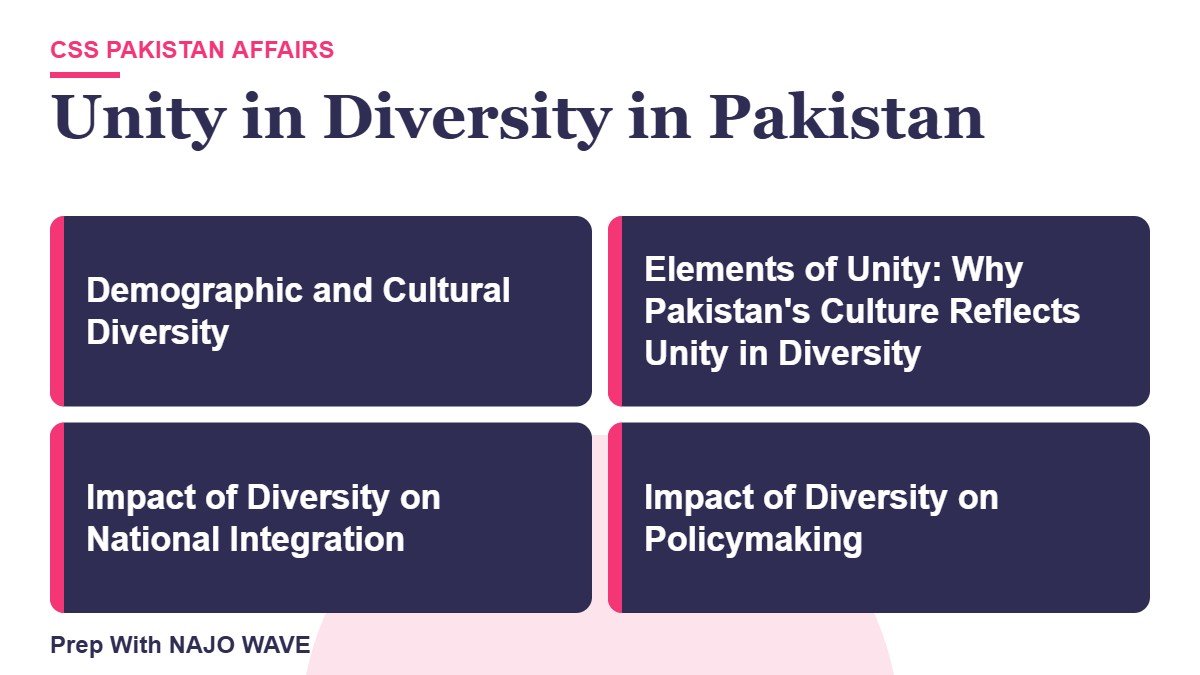
- Demographic and Cultural Diversity: Ethnic and linguistic diversity; Religious and sectarian diversity; Regional and geographic diversity; Demographic trends; An ancient heritage
- Elements of Unity: Why Pakistan’s Culture Reflects Unity in Diversity: Islam as a common bond; Sufi tradition; Urdu as the link language; Shared history and national symbols; Common social values and popular culture
- Impact of Diversity on National Integration: Positive impact; Negative impact when mismanaged
- Impact of Diversity on Policymaking: Federal design; Resource distribution and the census; Language and education policy; Representation and quotas; Security and development policy
- Way Forward
- Conclusion
Reference colours:
Quotation / documentPersonality / historySyllabus bookCurrent referenceOfficial report / policy
1. Introduction
Pakistan is one of the most diverse countries in the world. Within its borders live Punjabis, Pashtuns, Sindhis, Seraikis, Mohajirs, Baloch, Brahuis, Hazaras, Kashmiris and the peoples of Gilgit-Baltistan, speaking more than seventy languages, following different sects and religions, and living in landscapes from the Karakoram to the Arabian Sea. This diversity is held together by a shared faith, history and national language, a culture of unity in diversity. Diversity itself is not a threat; it becomes a source of conflict only when it is ignored or suppressed in policymaking. This answer analyses Pakistan’s demographic and cultural diversity, the elements that unite it, and its impact on national integration and policymaking. Its argument is that Pakistan’s diversity is a strength when managed through inclusive federal policies, and a fault line when it is not.
2. Demographic and Cultural Diversity
Ethnic and linguistic diversity
No single language group is a majority: Punjabi is spoken by about 37%, Pashto by 18%, Sindhi by 14%, Saraiki by 12%, Urdu by 9% and Balochi by about 3%. Each group has its own literature, music, poetry and customs, from Sufi poetry in Sindhi and Punjabi to Pashto tappay and Balochi epics.
Religious and sectarian diversity
The vast majority are Muslims, Sunni and Shia, with Barelvi, Deobandi and Ahl-e-Hadith traditions, alongside Hindu, Christian, Sikh and other communities.
Regional and geographic diversity
Pakistan’s mountains, deserts, river plains and coast have shaped different ways of life, pastoral, tribal, agricultural and urban, and distinct regional cultures in Punjab, Sindh, Khyber Pakhtunkhwa, Balochistan and Gilgit-Baltistan.
Demographic trends
Pakistan is the world’s fifth most populous country, with a very young population and rapid urbanisation; big cities such as Karachi and Lahore are melting pots where people from all regions live together.
An ancient heritage
The land of Pakistan carries the heritage of the Indus Valley civilisation, Gandhara, the Muslim sultanates and the Mughals, layers of history that all regions share.
3. Elements of Unity: Why Pakistan’s Culture Reflects Unity in Diversity
Islam as a common bond
Islam provides shared values, festivals such as the two Eids and Ramazan, and a common moral and spiritual framework across all regions.
Sufi tradition
Shrines such as those of Data Ganj Bakhsh, Lal Shahbaz Qalandar, Shah Abdul Latif Bhittai and Rahman Baba are revered by people of every province, and their message of love and tolerance unites ethnic groups.
Urdu as the link language
Urdu, the national language, is understood across Pakistan and connects people who speak different mother tongues; its use has grown, as the 2023 census shows.
Shared history and national symbols
The memory of the Pakistan Movement, the Quaid and Iqbal, the national anthem, flag and national days create a common national identity.
“We are now all Pakistanis, not Baluchis, Pathans, Sindhis, Bengalis, Punjabis and so on, and as Pakistanis we must feel, behave and act, and we should be proud to be known as Pakistanis and nothing else.”
Quaid-i-Azam, 1948 (as widely quoted)
Common social values and popular culture
Hospitality, respect for elders, family ties, cricket, music, dress such as shalwar kameez, and shared food link people across regions.
4. Impact of Diversity on National Integration
Positive impact
Cultural richness and soft power
Diversity enriches literature, music, crafts and tourism, and projects a positive image of Pakistan abroad.
Political pluralism
Diversity has produced a multi-party federation in which no single group can dominate, encouraging bargaining and coalition-building.
Negative impact when mismanaged
Ethnic and provincial grievances
When groups feel excluded from power or resources, ethnicity becomes a vehicle for protest, as in East Pakistan, Balochistan and Karachi. East Pakistan separated because of political exclusion, economic disparity and Indian military intervention, not because Bengali Muslims rejected their Muslim identity. Bangladesh did not merge with India; it became a second Muslim-majority sovereign state, which is consistent with the original plural “States” of 1940.
Sectarian and religious tensions
Sectarian violence and discrimination against minorities have damaged social harmony.
Language disputes
Language controversies, Bengali in 1948-52 and the Sindhi-Urdu riots of 1972, show how sensitive language policy is.
5. Impact of Diversity on Policymaking
Federal design
Diversity requires power-sharing: a federal system, equal representation in the Senate and the 18th Amendment’s provincial autonomy are responses to it.
Resource distribution and the census
Because population determines seats and resources, the census and the NFC Award are politically sensitive; disputes over the 2017 and 2023 censuses and over the NFC formula show how diversity shapes fiscal policy.
Language and education policy
Policymakers must balance Urdu, English and regional languages in schools and government; provinces such as Sindh teach in their own language.
Representation and quotas
Regional quotas in the civil service, universities and reserved seats for minorities and women are tools for inclusion.
Security and development policy
Grievances in Balochistan and the former FATA mean that security, development and political dialogue must be combined.
- Managed inclusively: richness, pluralism, stronger federation
- Policy choice: federalism, fair resources, language respect
- Ignored or suppressed: grievance, separatism, conflict
6. Way Forward
Pakistan should celebrate diversity as part of national identity in its curriculum and media; protect and promote regional languages alongside Urdu; implement genuine federalism and fair resource sharing; guarantee equal citizenship and protection to religious minorities and all sects; ensure fair representation in national institutions; and build bridges between regions through inter-provincial exchanges, festivals and youth programmes.
7. Conclusion
Pakistan’s ethnic, linguistic, religious and regional diversity is held together by a shared faith, the Sufi tradition, Urdu, a common history and common social values, a true culture of unity in diversity. This diversity has enriched Pakistan’s culture and politics, but when it has been met with centralisation and exclusion, it has fuelled grievance and even separation. Inclusive federal policies, fair sharing of resources and equal citizenship can make diversity Pakistan’s greatest strength rather than its weakness.
Related answers on this topic
- East Pakistan and the Two-Nation Theory
- National Integration Crisis in Pakistan
- Provincial Autonomy and Integration
- Regional and Nationalist Parties
- Equitable Distribution of Resources
- The unrest in Balochistan
More preparation: See all CSS Pakistan Affairs past papers by topic.
Last updated: 2 November 2026.
Preparing for CSS 2027? Subscribe to Prep With NAJO WAVE for more Pakistan Affairs answers.


