
Syllabus topic: Topic XII of the CSS Pakistan Affairs syllabus.
Short answer
Islamisation under Zia responded to a real aspiration: Pakistan was created in the name of Islam, and many people wanted its laws and economy to reflect Islamic values. But a programme imposed by a military ruler, centred on punishments rather than social justice, and tied to referendums and postponed elections, was above all a tool of political legitimacy and regime survival.
Outline for quick revision
- Introduction
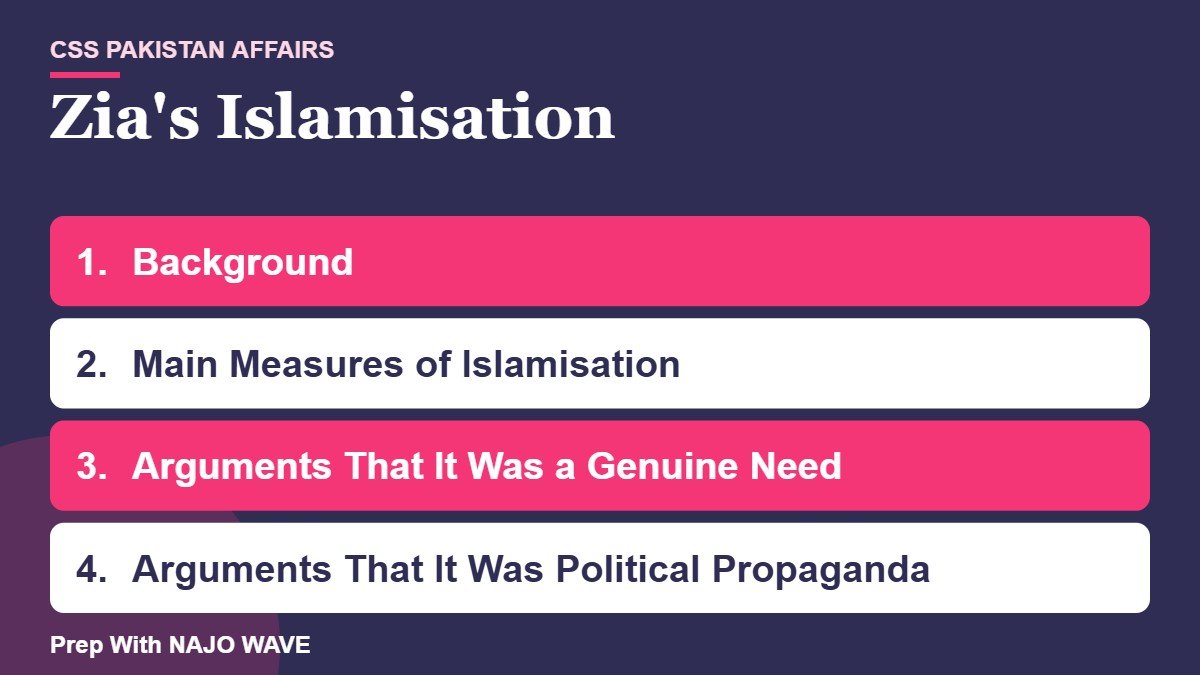
- Background: The 1977 movement; The ideological debate since 1947; International context
- Main Measures of Islamisation: Legal; Economic; Constitutional and political; Education and society
- Arguments That It Was a Genuine Need: Fulfilling the ideology of Pakistan; Popular demand; Lasting institutions
- Arguments That It Was Political Propaganda: Legitimacy for military rule; Selective and punitive; Suppression of opposition; Courts and the doctrine of necessity; Strategic convenience
- Consequences for Pakistan: Sectarianism; Women and minorities; Extremism and militancy; Constitutional imbalance; Departure from the founder’s vision
- Conclusion
Reference colours:
Quotation / documentPersonality / historySyllabus bookCurrent referenceOfficial report / policy
1. Introduction
General Zia-ul-Haq seized power on 5 July 1977 and ruled until his death on 17 August 1988. His government launched the most extensive programme of Islamisation in Pakistan’s history, in law, the economy, education and the media. Pakistan was created in the name of Islam, and a genuine popular demand for an Islamic order existed. But Zia was a military ruler without a mandate, and Islam became the main source of his legitimacy. This answer evaluates both sides and argues that Islamisation answered a real aspiration, but under Zia it was used mainly as a political instrument, selective, punitive and centred on regime survival.
“Pakistan is like Israel, an ideological state. Take out the Judaism from Israel and it will fall like a house of cards. Take Islam out of Pakistan and make it a secular state; it would collapse.”
General Zia-ul-Haq, interview with The Economist, December 1981 (as widely quoted)
2. Background
The 1977 movement
The opposition Pakistan National Alliance turned its protest against the alleged rigging of the March 1977 elections into the Nizam-e-Mustafa movement. The movement showed that the demand for an Islamic order could mobilise the masses, and Bhutto himself conceded measures such as a ban on alcohol. Zia, who took power during this crisis, inherited and used this mood.
The ideological debate since 1947
The role of Islam in the state had been debated since the Objectives Resolution of 1949. The 1973 Constitution declared Islam the state religion and created the Council of Islamic Ideology, but the actual Islamisation of laws remained slow. This gap between promise and practice gave Zia an opening.
International context
The Iranian Revolution (1979) made religion a powerful political force in the region, and the Soviet invasion of Afghanistan (December 1979) turned Pakistan into the base of a US-and Saudi-backed jihad. This brought money, weapons and international support to Zia and made Islam a strategic as well as a domestic tool.
3. Main Measures of Islamisation
Legal
The Hudood Ordinances (1979) introduced Islamic punishments for theft, adultery, false accusation and alcohol. Shariat Benches (1978) were replaced by the Federal Shariat Court (1980), empowered to strike down laws repugnant to Islam. The Qanun-e-Shahadat (1984) changed the law of evidence; the blasphemy laws were tightened (Section 295-B in 1982 and 295-C in 1986); and Ordinance XX (1984) restricted Ahmadis.
Economic
The Zakat and Ushr Ordinance (1980) made the state collect zakat by deducting it directly from bank accounts and ushr on agricultural produce, to be distributed through zakat committees. Banks introduced interest-free “profit and loss sharing” accounts as a first step towards an Islamic financial system, though interest continued in practice.
Constitutional and political
Zia appointed a nominated Majlis-e-Shura (1981) in place of an elected parliament. The Eighth Amendment (1985) made the Objectives Resolution a substantive part of the Constitution (Article 2A), but in the same package gave the President the power to dismiss elected governments (Article 58(2)(b)), a sign of how Islamisation and personal power were combined.
Education and society
Islamiat and Pakistan Studies became compulsory subjects, and the curriculum was revised along ideological lines. Madrassas expanded rapidly with zakat and foreign funds; prayer breaks were organised in offices, and dress and media codes were promoted on television and in public life.
4. Arguments That It Was a Genuine Need
Fulfilling the ideology of Pakistan
Pakistan was demanded in the name of Islam, and the Objectives Resolution and the Constitution promised an order based on its principles. Many believed that earlier governments had ignored this promise, so Zia’s measures were seen by supporters as overdue fulfilment of the ideology of Pakistan. In the Allahabad Address he said: “Islam is not a Church. It is a State.” Muslims could not accept a system in which their religion was confined to private life.
Popular demand
The Nizam-e-Mustafa movement of 1977 and the street power of religious parties showed that a large part of society wanted Islamic laws. Religious parties such as the Jamaat-e-Islami initially supported Zia’s programme, giving it a popular base.
Lasting institutions
Several of Zia’s institutions, the Federal Shariat Court, the zakat system and Islamic banking, have survived every later government, civilian and military. The goal of an interest-free economy has even been reaffirmed by the courts and Parliament, which suggests a lasting national demand rather than mere propaganda.
5. Arguments That It Was Political Propaganda
Legitimacy for military rule
Zia promised elections within 90 days, then postponed them repeatedly and hanged Bhutto in 1979. With no electoral mandate, he used Islamisation as the justification for his continued rule, presenting himself as the guardian of Pakistan’s ideology.
Selective and punitive
The programme focused on punishments, rituals and personal conduct rather than on social justice, land reform, accountability of the powerful or the welfare of the poor, which are at the core of the Islamic social order. This selectivity suggests that the aim was control, not transformation.
Suppression of opposition
Islam was used to delegitimise the PPP and the Movement for the Restoration of Democracy (1983), which was crushed by force. Political parties were banned, the press was censored, and the 1985 elections were held on a non-party basis to keep organised opposition out of power.
Courts and the doctrine of necessity
The Supreme Court validated the coup in the Nusrat Bhutto case (1977) under the doctrine of necessity, and judges were later forced to take a fresh oath under the Provisional Constitutional Order (1981). The courts thus became part of the system that legitimised Zia’s rule.
Strategic convenience
Islamisation fitted perfectly with the Afghan jihad. It helped mobilise volunteers and justify Pakistan’s role, and in return brought billions of dollars in US and Saudi aid and international support to a regime that had been isolated after Bhutto’s execution.
6. Consequences for Pakistan
Sectarianism
Imposing one school’s interpretation through state law divided Muslims. Compulsory zakat led to large Shia protests in Islamabad (July 1980) and an exemption for those who objected; sectarian organisations multiplied in the 1980s, and sectarian violence continues to this day.
Women and minorities
The Hudood laws were widely criticised because rape victims who could not prove their case risked prosecution for adultery; the Women’s Action Forum was formed in 1981 to resist them, and they were reformed by the Women’s Protection Act 2006. The blasphemy laws remain open to misuse against minorities and personal rivals.
Extremism and militancy
The unregulated expansion of madrassas, together with weapons and fighters from the Afghan jihad, produced armed groups and a culture of militancy. The “Kalashnikov and heroin culture” of the 1980s later turned against Pakistan itself.
Constitutional imbalance
The President’s power under Article 58(2)(b) was used to dismiss four elected governments between 1988 and 1996, creating the instability of the 1990s. It was finally removed by the 18th Amendment (2010).
Departure from the founder’s vision
The Quaid wanted a modern, democratic state guided by Islamic principles of equality, justice and tolerance, not a theocracy ruled by decree. Zia’s model, imposed by a military ruler, moved away from this vision.
“In any case Pakistan is not going to be a theocratic State to be ruled by priests with a divine mission. We have many non-Muslims, Hindus, Christians, and Parsis, but they are all Pakistanis.”
Quaid-i-Azam, broadcast to the people of the USA, February 1948
- Genuine need: ideology, popular demand, lasting institutions
- Political tool: legitimacy, selectivity, suppression, strategy
- Verdict: a real aspiration used as a political instrument
7. Conclusion
Islamisation under Zia responded to a real aspiration: Pakistan was created in the name of Islam, and many people wanted its laws and economy to reflect Islamic values. But a programme imposed by a military ruler, centred on punishments rather than social justice, and tied to referendums and postponed elections, was above all a tool of political legitimacy and regime survival. Its legacy, sectarianism, extremism, misuse of laws and constitutional imbalance, still shapes Pakistan. The lesson is that Islamic principles of justice, equality and accountability are best realised through democratic consensus, not through authoritarian decree.
Related answers on this topic
More preparation: See all CSS Pakistan Affairs past papers by topic.
Last updated: 2 November 2026.
Preparing for CSS 2027? Subscribe to Prep With NAJO WAVE for more Pakistan Affairs answers.