
Syllabus topic: Topic XVI of the CSS Pakistan Affairs syllabus.
Short answer
Unequal distribution of resources has been one of the deepest causes of Pakistan’s regional grievances, from East Pakistan in 1971 to Balochistan, Sindh and the merged districts today. Pakistan already has a strong constitutional framework in the NFC, the 18th Amendment and provincial resource rights; the task now is to make it work fairly.
Outline for quick revision
- Introduction
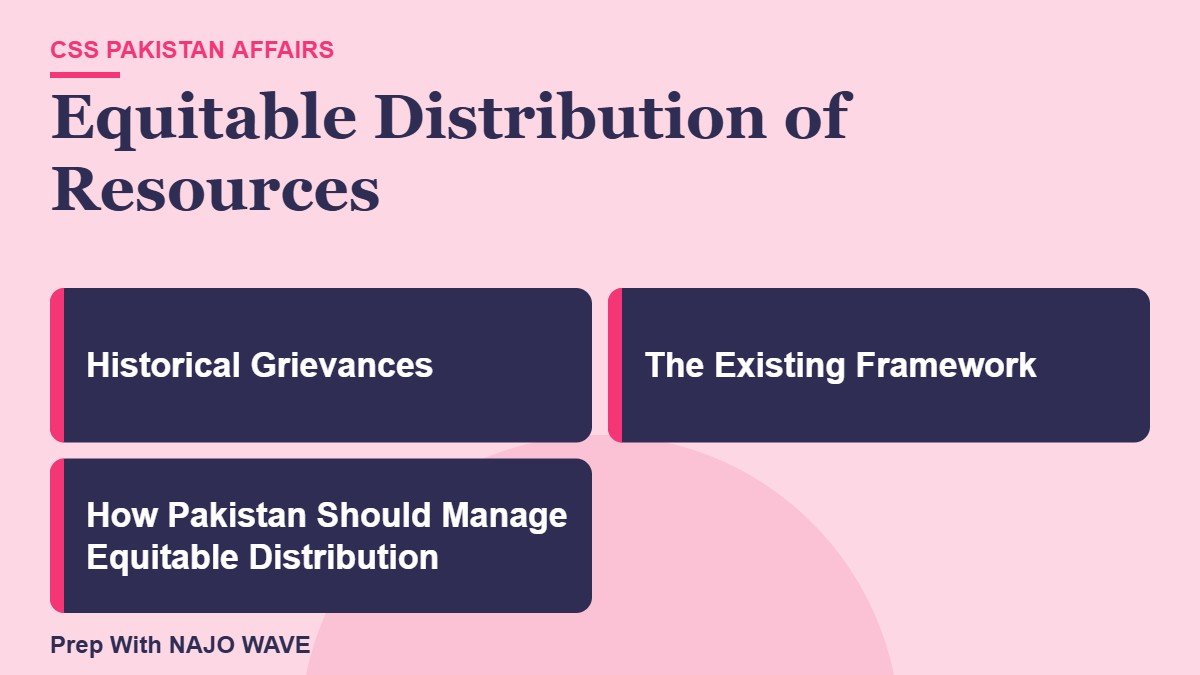
- Historical Grievances: East Pakistan; Balochistan; Sindh; Khyber Pakhtunkhwa and the merged districts; Within provinces
- The Existing Framework: The NFC Award; Constitutional resource rights; Federal development spending
- How Pakistan Should Manage Equitable Distribution: Fiscal measures; Development measures; Political and institutional measures
- Conclusion
Reference colours:
Quotation / documentPersonality / historySyllabus bookCurrent referenceOfficial report / policy
1. Introduction
Few issues have shaped Pakistan’s unity as much as the distribution of resources among its regions. The sense that East Pakistan’s jute earnings were spent in the West, that Balochistan’s gas lit up other provinces first, and that Sindh does not receive its share of Indus water has fed grievances and, at times, separatism.
The question asks “how” Pakistan should manage equitable distribution, so after explaining the grievances and the current framework, this answer gives the main weight to a strategy. Its argument is that equity means sharing according to need and contribution, not only population, and that resources must reach people and districts, not just provincial capitals.
2. Historical Grievances
East Pakistan
The perception of economic exploitation, foreign exchange earned in the East but development spent in the West, was a major cause of the separation of 1971. East Pakistan separated because of political exclusion, economic disparity and Indian military intervention, not because Bengali Muslims rejected their Muslim identity. Bangladesh did not merge with India; it became a second Muslim-majority sovereign state, which is consistent with the original plural “States” of 1940.
Balochistan
Gas was discovered at Sui in 1952 and supplied to other provinces long before most of Balochistan received it; disputes over royalties, jobs in projects such as Gwadar and Saindak, and control of minerals continue.
Sindh
Sindh complains of short supply of Indus water under the 1991 Water Accord, opposes new dams and canals upstream, and objects to under-representation in federal jobs.
Khyber Pakhtunkhwa and the merged districts
KP demands its full share of hydroelectric profits from its dams and the promised funds for the former FATA, devastated by war.
Within provinces
Southern Punjab, interior Sindh and northern Balochistan feel neglected by their own provincial capitals, inequality exists within provinces as much as between them.
3. The Existing Framework
The NFC Award
The 7th NFC Award introduced multiple criteria, including poverty and inverse population density, and raised the provinces’ share to 57.5%; the 18th Amendment protects this share from being reduced.
Constitutional resource rights
Articles 158, 161 and 172(3) give provinces priority in gas use, royalties and hydel profits, and joint ownership of oil and gas.
Federal development spending
The Public Sector Development Programme (PSDP), CPEC projects and special packages for Balochistan and the merged districts are meant to reduce regional gaps, but their distribution has often been political.
4. How Pakistan Should Manage Equitable Distribution
Fiscal measures
A fair, consensual NFC Award
Agree the next NFC Award by consensus in the Council of Common Interests, increasing the weight of poverty, backwardness and area alongside population, and adding incentives for provinces to raise their own revenue.
Provincial Finance Commissions
Each province should establish a Provincial Finance Commission that passes funds on to districts by a transparent, need-based formula, so that southern Punjab, interior Sindh and remote Balochistan receive their share.
Honour resource rights
Pay royalties, gas development surcharge and hydel profits on time and in full, clear historical arrears, and give producing districts a fixed share of their own resource revenues.
Development measures
Targeted development of lagging regions
Direct a larger share of federal and CPEC spending to the poorest districts, guided by poverty and human development data rather than political bargaining.
- Need: poverty, backwardness, area
- Contribution: resources produced, revenue collected
- Performance: results in health, education, revenue
Reserve jobs, training and contracts in projects such as Gwadar, Reko Diq and Thar coal for local people, and invest part of the revenues in local schools, hospitals and water.
Human development first
Close regional gaps in education and health, especially for girls, because human capital is the resource that lasts longest.
Political and institutional measures
Strengthen the CCI and IRSA
Resolve disputes over water, gas and the census in the Council of Common Interests and make the Indus River System Authority transparent, with telemetry to measure flows.
Fair representation
Enforce provincial quotas in federal jobs and ensure that smaller provinces are represented in decision-making bodies.
Dialogue with aggrieved groups
Combine development with political dialogue, especially in Balochistan, where grievances over missing persons and security operations must be addressed alongside economic ones.
5. Conclusion
Unequal distribution of resources has been one of the deepest causes of Pakistan’s regional grievances, from East Pakistan in 1971 to Balochistan, Sindh and the merged districts today. Pakistan already has a strong constitutional framework in the NFC, the 18th Amendment and provincial resource rights; the task now is to make it work fairly. A consensual, need-based NFC Award, Provincial Finance Commissions, full payment of resource rights, targeted development of lagging districts, local benefit from mega-projects and political dialogue can turn resources from a source of grievance into a foundation of national unity.
Related answers on this topic
- East Pakistan and the Two-Nation Theory
- National Integration Crisis in Pakistan
- Provincial Autonomy and Integration
- Unity in Diversity in Pakistan
- Regional and Nationalist Parties
- The unrest in Balochistan
More preparation: See all CSS Pakistan Affairs past papers by topic.
Last updated: 2 November 2026.
Preparing for CSS 2027? Subscribe to Prep With NAJO WAVE for more Pakistan Affairs answers.