Introduction
Feminism is both a theory and a social movement that seeks to end women’s subordination and establish gender equality. It studies how patriarchy, economy, culture, law, politics, and social institutions create unequal relations between men and women. In simple words, feminism demands equality, dignity, justice, and freedom for women.
Definition of Feminism
Feminism means the belief that women and men should enjoy equal rights, opportunities, and respect in all spheres of life. It is not a movement against men; rather, it is a movement against sexism, exploitation, discrimination, and oppression. bell hooks defines feminism as “a movement to end sexism, sexist exploitation, and oppression.”
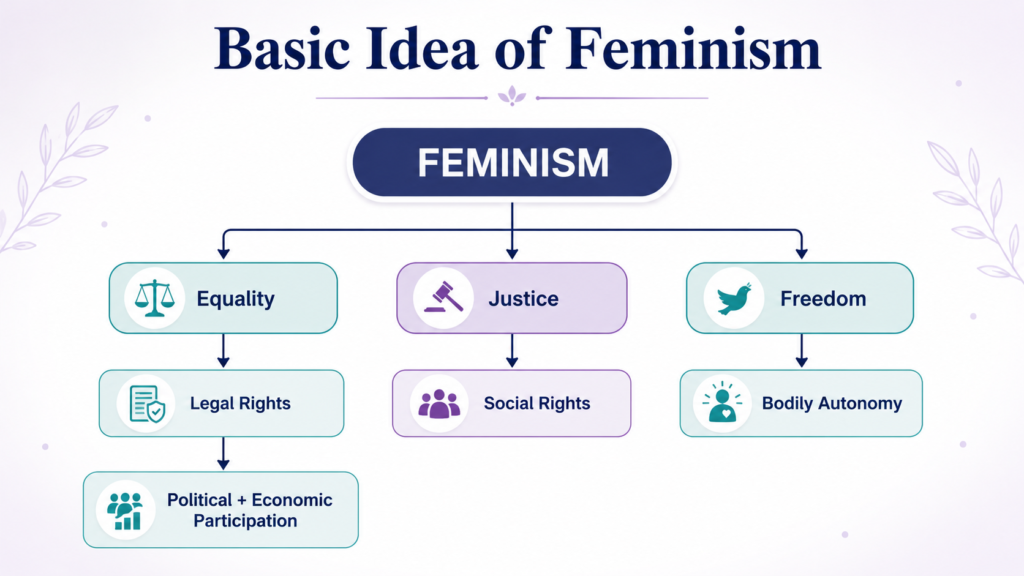
This diagram shows that feminism is not limited to one field. It includes legal, social, political, economic, and personal freedom. Therefore, feminism is a broad struggle for women’s complete human development.
Feminism as an Ideology
As an ideology, feminism questions male dominance in society. It argues that gender inequality is not natural but socially constructed. Simone de Beauvoir writes in The Second Sex, “One is not born, but rather becomes, a woman.” This means society teaches women to behave in subordinate roles.
Feminism as a Movement
As a movement, feminism has struggled for women’s suffrage, education, property rights, equal wages, reproductive rights, political representation, and protection from violence. It has challenged those customs, laws, and institutions that keep women dependent on men. Thus, feminism combines theory with practical struggle.
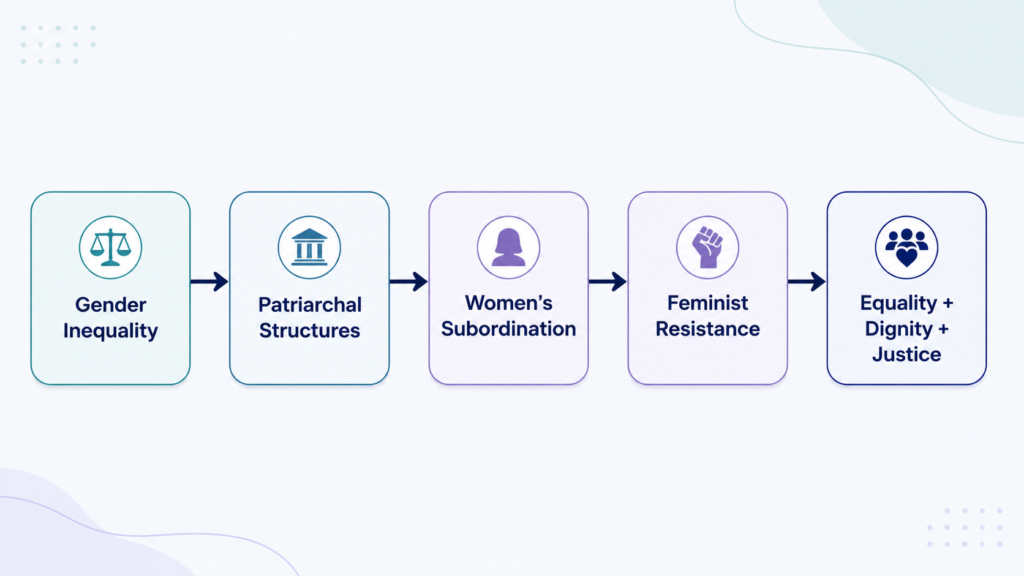
This flow chart explains how feminism understands women’s oppression. Women’s inequality is not accidental; it is produced by social structures. Feminism resists these structures and aims to create a just society.
Major Schools of Feminism
There are many schools of feminism, including liberal feminism, radical feminism, Marxist feminism, socialist feminism, ecofeminism, postmodern feminism, and Islamic feminism. These schools agree that women face oppression, but they differ about the root cause of this oppression and the best method of liberation.
What is Radical Feminism?
Radical feminism argues that patriarchy is the oldest, deepest, and most universal form of oppression. It believes that men as a class dominate women as a class. Radical feminists focus on family, sexuality, reproduction, body politics, violence, and male control over women’s lives.
Main Argument of Radical Feminism
The main argument of radical feminism is that “the personal is political.” It means women’s private experiences, such as marriage, motherhood, domestic work, sexual violence, and reproductive control, are actually political issues. These experiences show how patriarchy controls women even inside the home.
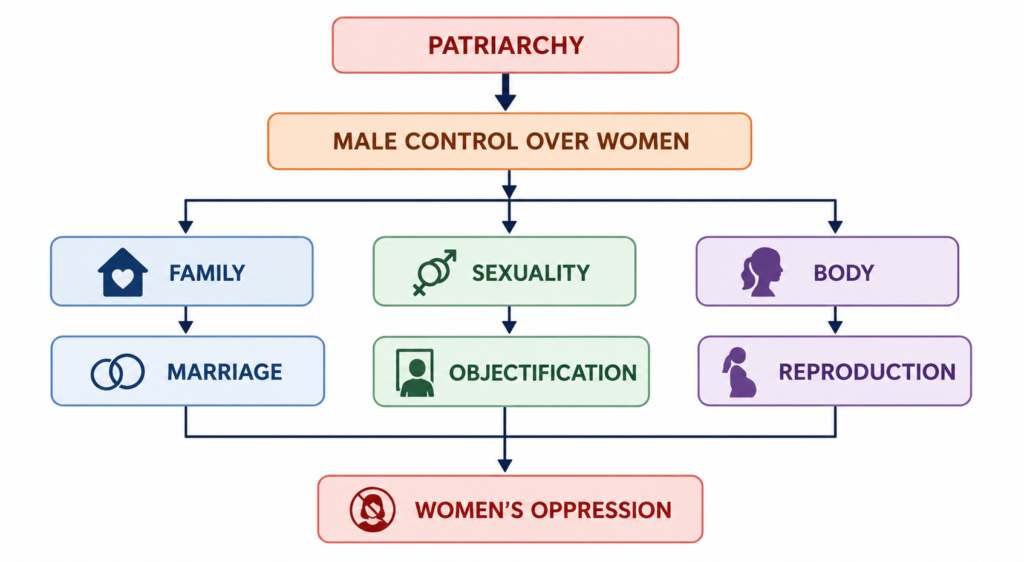
This diagram shows that radical feminism sees patriarchy as the main root of women’s oppression. According to radical feminists, women are controlled through family structures, sexual norms, and control over their bodies.
Radical Feminism on Family and Body
Radical feminists criticise the traditional family because they see it as a major institution of patriarchy. Kate Millett, in Sexual Politics, argues that power relations exist even in personal and sexual life. Shulamith Firestone also linked women’s oppression with biological reproduction in The Dialectic of Sex.
What is Socialist Feminism?
Socialist feminism combines feminist analysis with socialist and Marxist thought. It argues that women are oppressed by both patriarchy and capitalism. Therefore, women’s inequality cannot be understood only through male domination; it must also be studied through class, labour, poverty, and economic exploitation.
Main Argument of Socialist Feminism
The main argument of socialist feminism is that gender oppression and class exploitation are interconnected. Women are exploited at home through unpaid domestic labour and outside the home through low-paid work. Therefore, socialist feminism studies both the family and the economy as sites of women’s oppression.
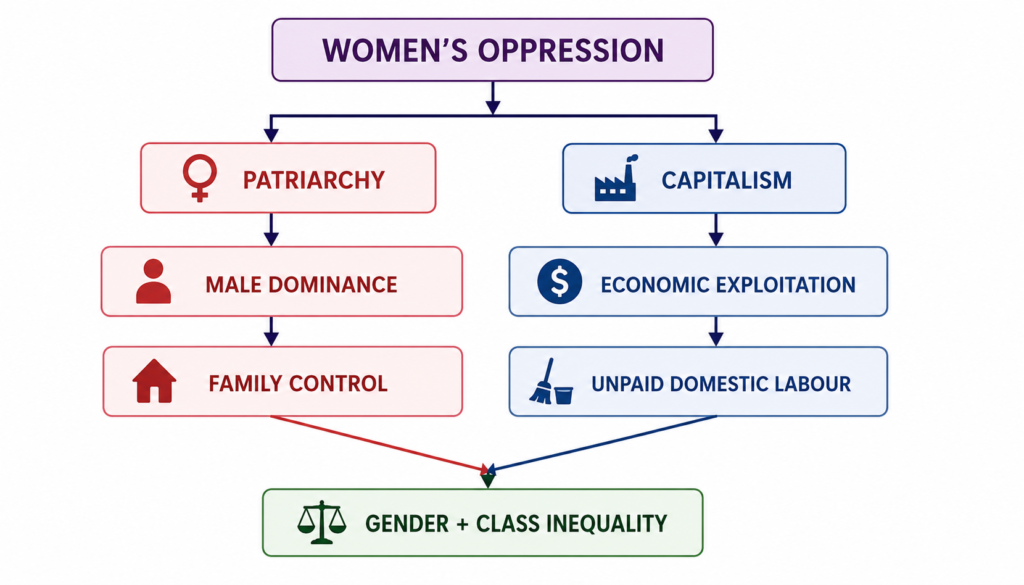
This diagram shows that socialist feminism gives a dual explanation. It believes women’s oppression is produced by both male dominance and capitalist exploitation. Therefore, women’s liberation requires gender justice as well as economic justice.
Socialist Feminism on Economy
Socialist feminists argue that capitalism benefits from women’s unpaid household work. Women cook, clean, raise children, and care for the family without wages. This unpaid labour reproduces the future labour force. Friedrich Engels, in The Origin of the Family, Private Property and the State, linked women’s oppression with private property.
Key Difference in Root Cause
The first major difference is about the root cause of women’s oppression. Radical feminism sees patriarchy as the main cause. Socialist feminism sees both patriarchy and capitalism as the causes. Therefore, radical feminism is more gender-centred, while socialist feminism is both gender-centred and class-centred.
Key Difference in Main Focus
Radical feminism focuses on sexuality, family, reproduction, rape, pornography, domestic violence, and body politics. Socialist feminism focuses on class, paid work, unpaid domestic labour, economic dependency, poverty, and capitalist exploitation. Thus, radical feminism focuses more on male power, while socialist feminism focuses more on economic structures.
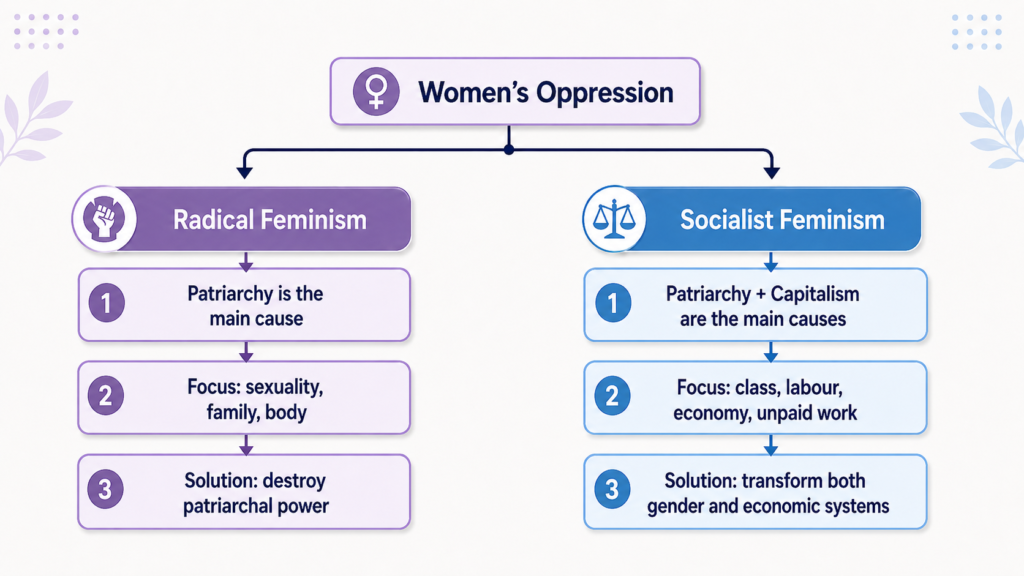
This is the central difference between the two schools. Radical feminism wants to destroy patriarchal power relations, while socialist feminism wants to transform both patriarchal and capitalist structures.
Difference in View of Men
Radical feminism often sees men as direct beneficiaries of patriarchy. It argues that men collectively hold power over women. Socialist feminism gives a more class-based explanation. It argues that working-class men may dominate women, but they are also exploited by the capitalist system.
Difference in Strategy
Radical feminism demands radical change in family, sexuality, culture, language, and social behaviour. Some radical feminists support women-only spaces and separatist politics. Socialist feminism demands equal wages, childcare, labour rights, welfare policies, social ownership, and restructuring of both family and economy.
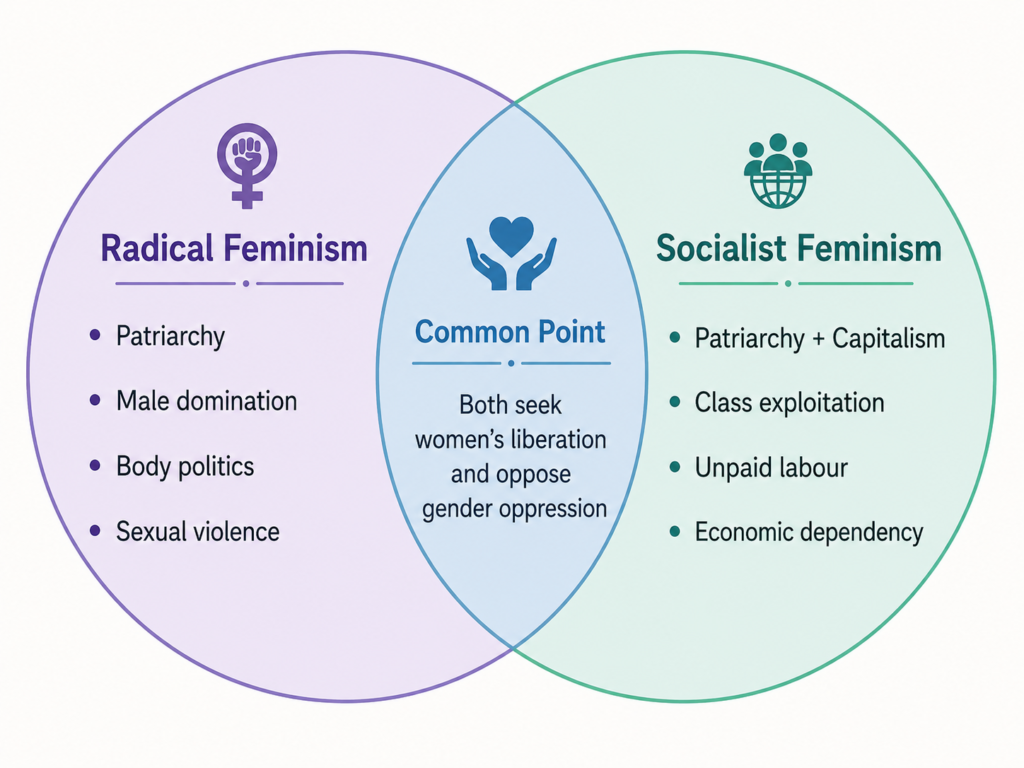
This Venn diagram shows that both schools are different in explanation but similar in purpose. Both reject women’s subordination and demand women’s liberation from oppressive structures.
Critical Evaluation
Radical feminism is important because it exposes hidden oppression in private life, especially sexual violence, domestic violence, and reproductive control. However, it is criticised for sometimes overgeneralising men as oppressors. Socialist feminism is strong because it links gender with class, but it may underemphasise sexuality and culture.
Contemporary Relevance
Both theories are relevant in today’s world. Radical feminism helps explain harassment, rape culture, forced marriages, domestic violence, and control over women’s bodies. Socialist feminism helps explain the gender pay gap, unpaid care work, feminisation of poverty, and exploitation of women workers in capitalist economies.
Conclusion
Feminism is a struggle for equality, dignity, and freedom from gender-based oppression. Radical feminism and socialist feminism both aim at women’s liberation, but they differ in their explanation and solution. Radical feminism considers patriarchy the main enemy, while socialist feminism sees women’s oppression as the result of both patriarchy and capitalism.